

Every January, a familiar pattern repeats. People resolve to save more, spend less, or finally get their financial house in order. Most abandon those resolutions before spring.
Willpower often gets blamed, but it's rarely the real cause. The research points to something more specific and more fixable.
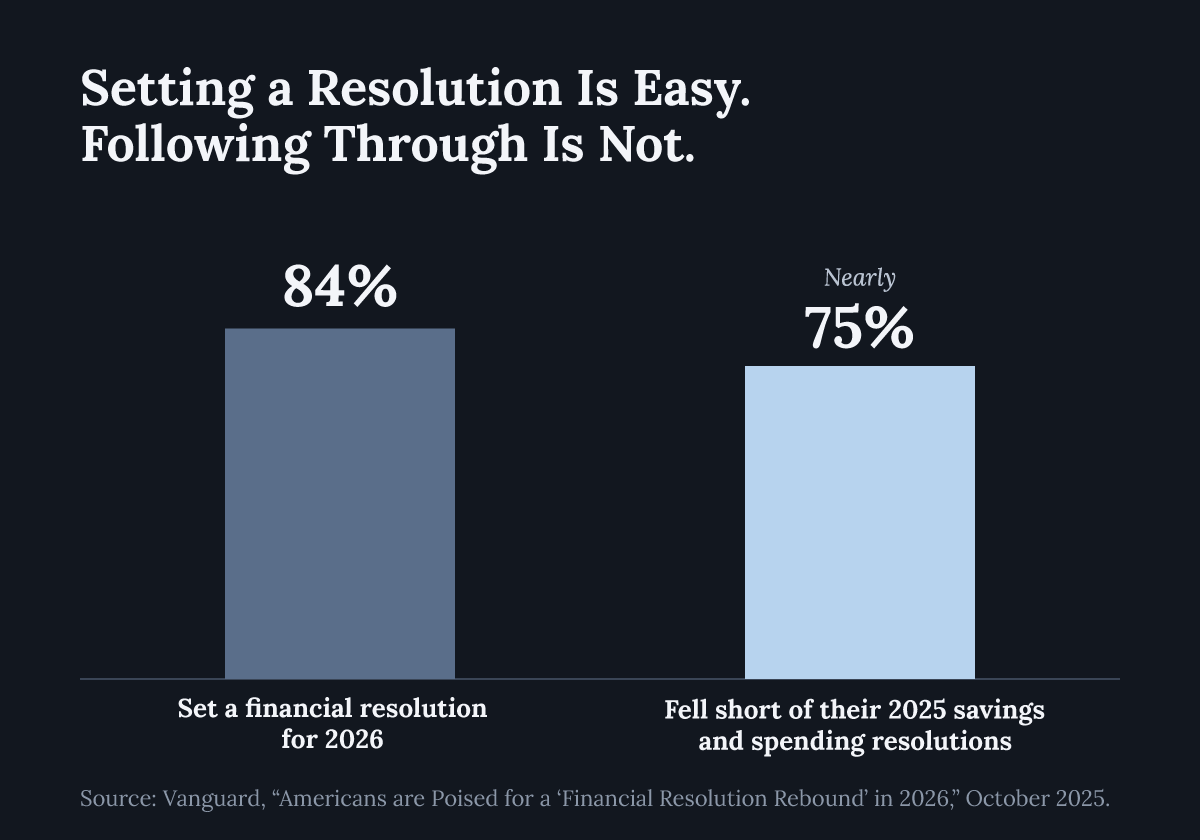
A 2025 Vanguard survey found that 84 percent of Americans set a financial resolution heading into 2026, yet nearly 75 percent admitted they had fallen short of the savings and spending resolutions they made for 2025.1
Fidelity's 17th Annual Resolutions Study, released in December 2025, found a similar pattern: 64 percent of people were considering a financial resolution for 2026, up from 56 percent the year before, meaning more people are trying and, based on the historical numbers, most will still struggle to follow through.2
Why Does the New Year Feel Like Such a Powerful Reset?
There's a psychological phenomenon behind that January feeling of a clean slate. It’s called the fresh start effect, and it suggests that people are more likely to pursue a goal right after a "temporal landmark," a moment that feels like a dividing line between an old version of yourself and a new one. A birthday, a Monday, and especially January 1 all function this way.3
The mechanism is what makes it interesting. The fresh start creates psychological distance from past failures. Those setbacks belong to the old you, and the new period belongs to a version of you that hasn't failed yet.
That reframe also explains why the boost fades. Psychological distance is the whole mechanism, and by February, it's usually gone. The bills still arrive on the same days. The same argument about spending comes up at the same point in the month. Whatever friction wore down last year's effort catches up with this year's version just as fast, calendar or not.4
What's the Real Difference Between a Resolution and a Goal?
"Save more this year" is a resolution. "Direct $3,000 a month from our joint account into a home renovation fund, automatically, on the 1st" is a goal with a mechanism attached.
That distinction sounds semantic, but it maps onto one of the most replicated findings in behavioral science. Psychologists call it an implementation intention, a term coined by Peter Gollwitzer for an if-then approach that specifies exactly when, where, and how a behavior will occur. He concluded that people who write a specific if-then approach are more likely to follow through than people who simply intend to do something.5
Picture two households with the identical goal of saving more this year. The first decides to set money aside when cash flow allows. The second sets up a standing instruction: the paycheck lands on the 15th; $1,500 moves automatically into a specific account; no decision is required. The automated system helps remove the moment of willpower, which can lead to more success.
Why Don't More Successful People Feel Successful?
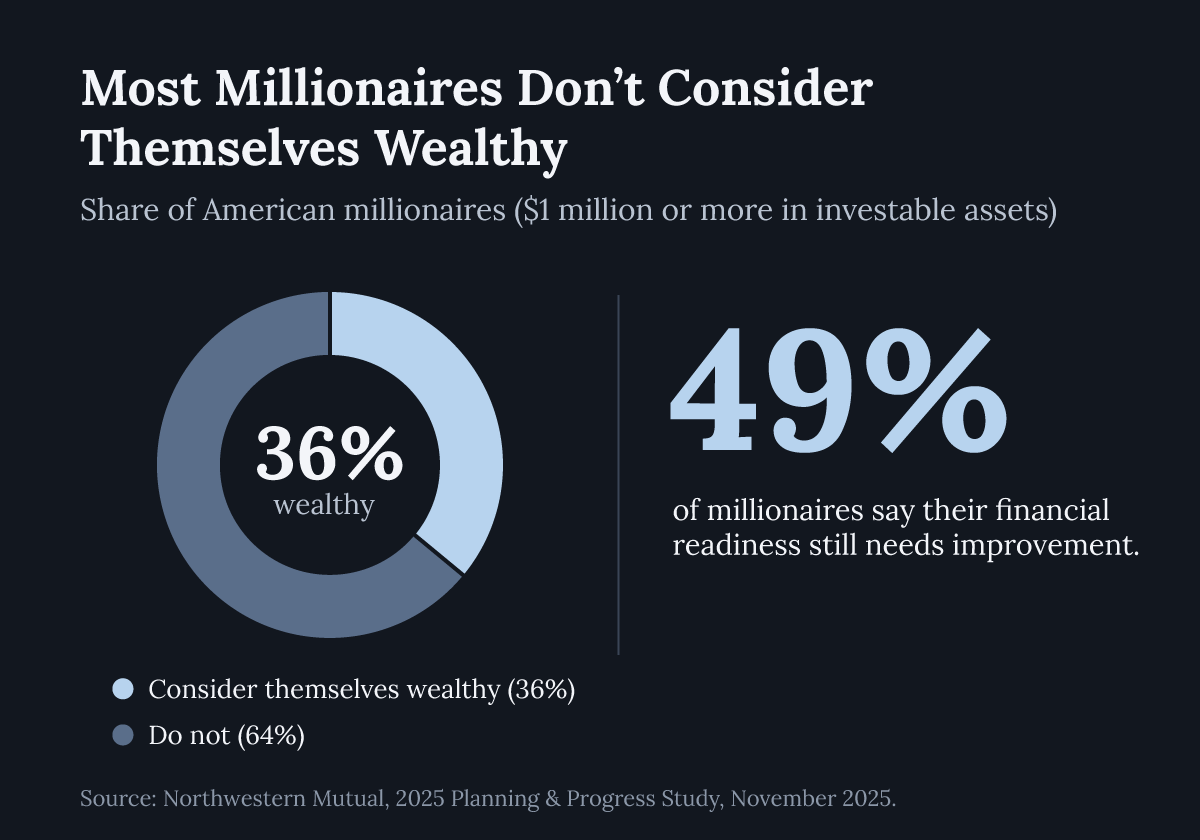
One statistic surprises almost everyone we share it with. In Northwestern Mutual's 2025 Planning & Progress Study, only 36 percent of American millionaires, people with $1 million or more in investable assets, said they consider themselves "wealthy."6
The same study found that 79 percent of these millionaires describe their wealth as self-made, yet nearly half (49 percent) say their financial readiness still needs improvement. Only 53 percent currently expect to leave an inheritance or charitable gift as part of their estate strategy, a number that reflects how much less settled even substantial wealth can feel than it looks from the outside.
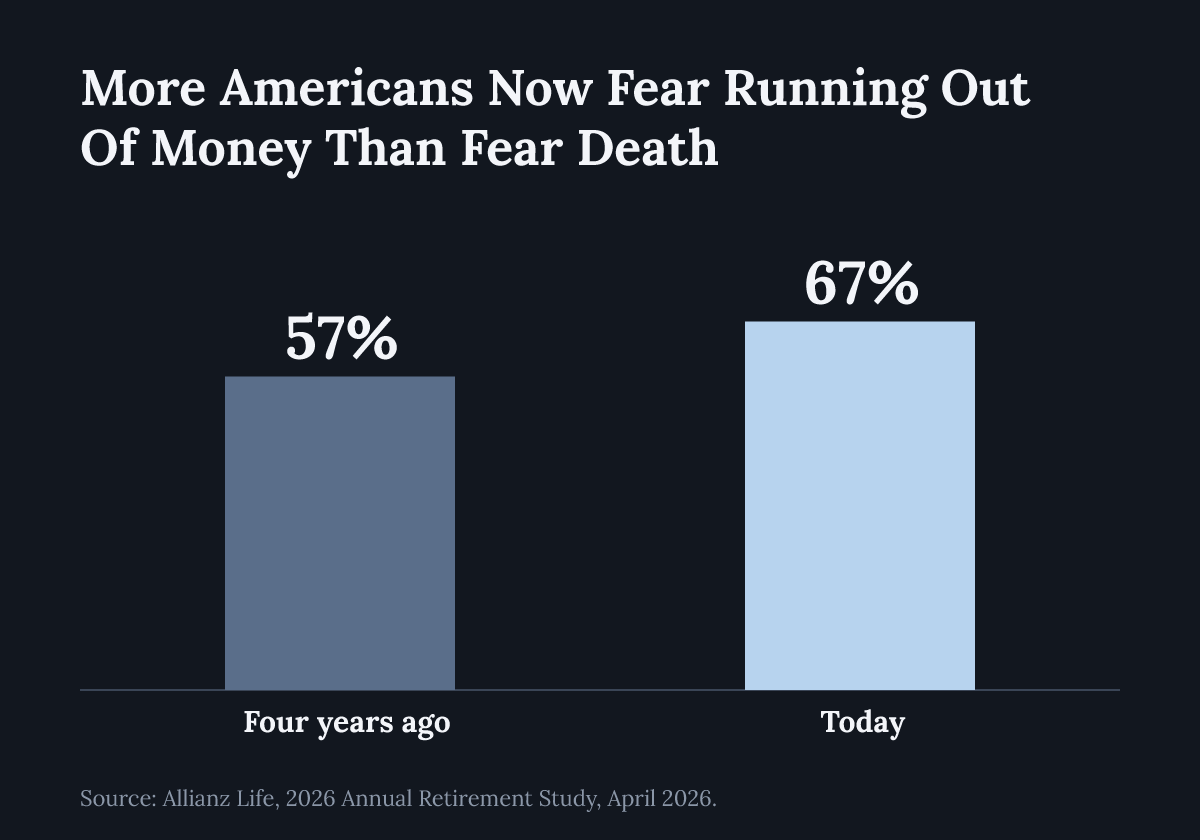
For some families, knowing what to do is rarely the problem. The harder part is translating competing priorities (spend now, preserve later, help the kids, protect the business) into decisions that can run without constant attention. That translation problem shows up in a related finding: 67 percent of Americans now say they worry more about running out of money than they do about death itself.7
This is worth sitting with because it runs counter to a common assumption: that reaching a number resolves the underlying uncertainty. It usually doesn't. What tends to close that gap is rarely more money. More often, it's a framework specific enough to answer the question "Is this actually enough, and for what?" backed by a withdrawal strategy with guardrails that turns a vague fear into a concrete monthly number.
The same Northwestern Mutual study found that millionaires who work with a financial professional report higher financial confidence than those who don't. Nobody's net worth changed to get that result. Their ability to answer one specific question about it did.
What Should You Look at Before the Year Starts?
Some decisions require better habits. Others just require staying current, since the start of a new year resets a handful of very specific numbers that are easy to miss and change annually.
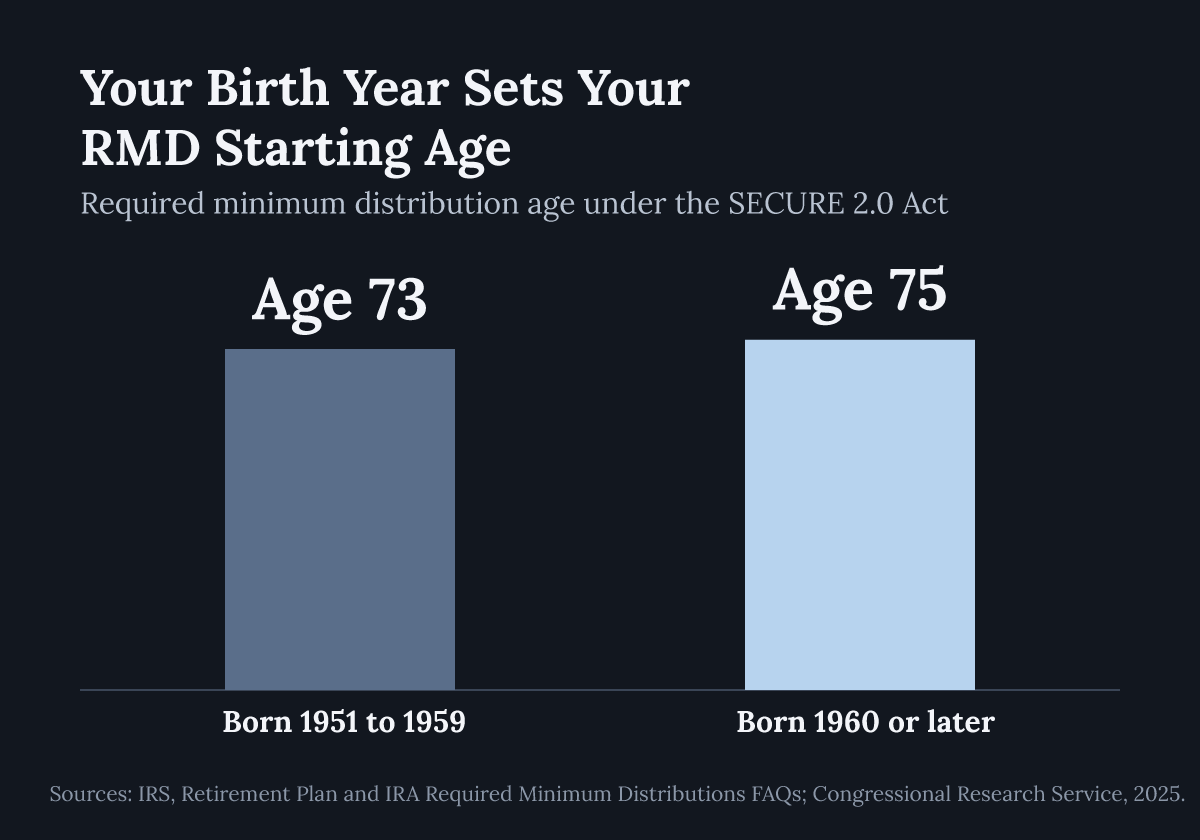
The age at which required minimum distributions, or RMDs, must begin depends on your birth year under the SECURE 2.0 Act. If you were born between 1951 and 1959, your RMD age is 73. If you were born in 1960 or later, it moves to 75.8
For those who are charitably inclined and RMD-eligible, the qualified charitable distribution limit for 2026 rises to $111,000 per person ($222,000 for a married couple), which can be given directly to charity this year, satisfying RMD requirements without adding to taxable income.9
What Do You Want This Year's Strategy to Accomplish?
The calendar can give people a temporary motivational lift. Vague resolutions can waste time. Specific, mechanical systems, the kind that don't require willpower in the moment, often survive past February. In some cases, greater specificity does more to resolve that uncertainty than simply reaching another financial milestone.
A focused effort in January attaching a mechanism to whatever matters most to you this year can make a difference. Think about something that runs on its own whether or not you remember to think about it in March. An idea that can't move when your priorities do isn't much of a strategy.
How Our Firm Can Help
A new year is a reason to revisit the approach, but the goal isn't another resolution. It's making sure the decisions that matter are reflected in how your financial life works day to day. If your priorities, circumstances, or assumptions have changed, that's worth a conversation.
Frequently Asked Questions
What is the difference between a financial resolution and a financial goal?
A resolution is typically a vague intention, such as "save more" or "spend less." A goal ties a specific number to a specific purpose and, ideally, a specific mechanism for making it happen automatically. Research on implementation intentions shows that the mechanism, not the intention, is what predicts follow-through.
Why do most New Year's financial resolutions fail?
Survey data suggest that most people fall short of meeting their financial resolutions within the year they set them. Behavioral research suggests that one reason intentions fail is the absence of a concrete framework for when and how the behavior will happen; specific if-then strategies remove the moment of willpower that vague intentions still require.
What is the required minimum distribution age in 2026?
Under the SECURE 2.0 Act, the RMD age is 73 for people born between 1951 and 1959 and 75 for people born in 1960 or later.
How much can I give to charity directly from my IRA in 2026?
The qualified charitable distribution limit for 2026 is $111,000 per person, up from $108,000 in 2025, based on the IRS's annual inflation adjustment.10
Should we meet with our financial professional at the start of every year?
Not necessarily. But during an annual review, remember to discuss year-end and new-year priorities. Use any review to prepare to turn new goals into a specific, automated process rather than a resolution.
1 Vanguard.com, October 29, 2025.
2 Fidelity.com, December 11, 2025.
3 PsychologyToday.com, September 2025.
4 OSU.edu, February 2023.
5 TandFonline.com, 2026.
6 Northwesternmutual.com, 2026.
7 AllianzLife.com, April 23, 2026.
8 IRS.gov, 2026.
9 IRAHelp.com, 2026.
10 Once you reach age 73, you must begin taking RMDs from a traditional IRA in most circumstances. Withdrawals from traditional IRAs are taxed as ordinary income and, if taken before age 59½, may be subject to a 10 percent federal income tax penalty.